San Antonio Missions National Historical Park


San Antonio Missions National Historical Park is a National Historical Park and World Heritage Site preserving four of the five Spanish frontier missions in San Antonio, Texas, USA. These outposts were established by Catholicreligious orders to spread Christianity among the local natives. These missions formed part of a colonization system that stretched across the Spanish Southwest in the 17th, 18th, and 19th centuries.
In geographic order from north (upstream of the San Antonio River) to south (downstream) the missions are located as follows: Mission Concepcion, Mission San Jose, Mission San Juan, and Mission Espada. The Espada Aqueduct, also part of the Park, is due east of Mission San Juan, across the river. The fifth (and best known) mission in San Antonio, the Alamo, is not part of the Park, rather it is owned by the State of Texas, and operated by the Daughters of the Republic of Texas; it is upstream from Mission Concepcion in Downtown San Antonio.

The Grand Staircase-Escalante National Monument


The Grand Staircase-Escalante National Monument is a U.S. National Monument protecting 1,880,461 acres (760,996 ha) of land in southern Utah. There are three main regions: the Grand Staircase, the Kaiparowits Plateau, and the Canyons of the Escalante - all of which are administered by the Bureau of Land Management as part of the National Landscape Conservation System. President Bill Clinton designated the area as a national monument in 1996 using his authority under the Antiquities Act. Grand Staircase-Escalante encompasses the largest land area of all U.S. National Monuments.


The Monument is managed by the Bureau of Land Management rather than the National Park Service. This was the first National Monument managed by the BLM. Visitor centers are located in Cannonville, Big Water, Escalante, and Kanab.
The Monument stretches from the towns of Big Water, Glendale and Kanab, Utah on the southwest, to the towns of Escalante and Boulder on the northeast. Encompassing 1.9 million acres, the monument is slightly larger in area than the state of Delaware.
The western part of the Monument is dominated by the Paunsaugunt Plateau and the Paria River, and is adjacent to Bryce Canyon National Park. This section shows the geologic progression of the Grand Staircase.

Geologic cross section of the Grand Staircase
The center section is dominated by a single long ridge, called Kaiparowits Plateau from the west, and called Fifty-Mile Mountain when viewed from the east. Fifty-Mile Mountain stretches southeast from the town of Escalante to the Colorado River in Glen Canyon. The eastern face of the mountain is a steep, 2200 foot (650 m)escarpment. The western side (the Kaiparowits Plateau) is a shallow slope descending to the south and west.

Spooky Gulch in the Canyons of the Escalante
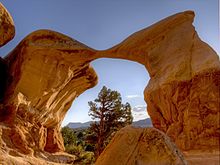
Metate Arch in the Devil's Garde
East of Fifty-Mile Mountain are the Canyons of the Escalante. The Monument is bound by Glen Canyon National Recreation Area on the east and south. The popular hiking, backpacking and canyoneering areas include the Canyons of the Escalante, shared with Glen Canyon National Recreation Area and Skutumpah and Cottonwood Roads. Highlights include the slot canyons of Peekaboo, Spooky and Brimstone Canyons, the Devil's Garden, Bull Valley Gorge, Willis Creek, Lick Wash and the backpacking areas of lower Coyote Gulch and of Harris Wash.
The Hole-in-the-Rock Road extends southeast from the town of Escalante, along the base of Fifty-Mile Mountain. It is important in the history of The Church of Jesus Christ of Latter-day Saints and the settlements of southeast Utah, including Bluff, as well as providing access to the Canyons of the Escalante, and to the flat desert at the base of Fifty Mile Mountain that is used for grazing cattle.

Top 10 places to visit in California


1. Disneyland
2. Universal Studios Hollywood
3. Disney California Adventure
4. Sea World San Diego
5. Golden Gate Bridge
6. San Diego Zoo
7. Yosemite National Park
8. Legoland California Resort
9. Balboa Park
10. Alcatraz Island

Busch Gardens Tampa- a park in the city of Tampa


Busch Gardens Tampa (formerly known as Busch Gardens Africa and Busch Gardens: The Dark Continent) is a 335-acre (136 ha) 19th century African-themed animal theme park located in the city of Tampa, Florida. It opened on March 31, 1959 as an admission-free hospitality facility for Tampa Anheuser-Busch; in addition to various beer tastings they had, a bird garden and the Stairway to the Stars which was an escalator that took guests to the roof of the brewery. You can get your own Busch Gardens guide here.
Busch Gardens continued to grow, and in 1965, opened the 29-acre Serengeti Plains, which allowed the African wildlife to roam freely. It continued to focus on its tropical landscape, exotic animals, and amusements to draw visitors. Busch Gardens began charging admission as the entertainment became more complex, with extra fees for the thrill rides, such as the roller coasters for which Busch Gardens is now known. Currently Busch Gardens competes with other such parks in Florida and charges comparable fees. The park is operated by SeaWorld Parks & Entertainment, majority owned by the private equity firm Blackstone Group. Busch Gardens is currently accredited by the Association of Zoos and Aquariums (AZA). In 2011, the park hosted 4.3 million people, placing in the Top 20 of the most-visited theme parks in the US and in the Top 25 worldwide.You can get your own Busch Gardens guide here.